Ir al contenido principal

How to check “Active” Activity Code

Origen: https://www.greytrix.com/blogs/sagex3/2013/05/02/how-to-check-active-activity-code/

By  | May 2, 2013

In Sage X3 we do many customizations and for each customization, we assign a unique activation code. The problem arrives when we write the code for different customization in single processing file and we have to deactivate one of the customizations.

In that case, we need to look for a hook which will restrict the processing of the code related to a particular specific customization.

To overcome the above problem X3 provides the feature of the Global variable to deactivate the Activity Code. To achieve this we need to do the following changes.

Navigate through Development->Data and Parameters->Development setup->Global variable

Create a new global variable that you want to use for the activity Code (refer below screenshot) and enter the formula for the activity code as:
func AFNC.ACTIV(“ACTCODE”)      (where ACTCODE is the Activity code that you are referring.)
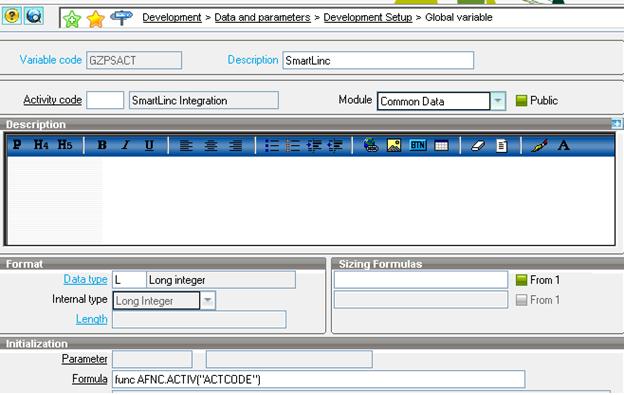
Now within the coding part w,e can check if this Global variable is true the code should process else not.

Hope this clarifies. 

Entradas populares de este blog

SAGE X3 SILENT IMPORT (IMPORTSIL) WITH ERROR CATCHING

FUENTE ORIGINAL: https://pluginx3.com/en/blog/post/sage-x3-silent-import-importsil-with-error-catching.html You already know how to manually generate a CSV file in order to import it threw a template in Sage X3. But If you wonder how to catch detailed errors after a silent import here is the solution. Sometimes you need to catch the incoming errors in order to alert the end-user regarding an issue. Closed period, wrong date etc …. Unfortunalty the standard Sage X3 silent import function doesn’t natively show the detailed errors during the import process. Call IMPORTSIL([M:IMP2]MODIMP,[M:IMP2]NOMIMP) From GIMPOBJ And the standard function ERR_IMPORT will only show the overall status of the importation and not the detailed errors. IMPORTSIL function is pushing all the log data into a tracefile in order to avoid any popup on end-user screen. So you have a log file available in order to search for errors in it. Sage X3 runtime is using the same principals standards as any shell for log...

Valores de fstat

Fstat fstat  is a numeric status that is returned upon execution of a database operation, a sequential file operation, or a lock instruction. Syntax fstat Examples # MYTABLE is a table with a key called KEY1, that has a unique component called KEYVAL # Create a record in the table MYTABLE with they key value 1 if it doesn't exist Local File MYTABLE [MYT] Read [MYT]KEY1=1 If fstat [MYT]KEYVAL=1 : Write [MYT] If fstat MSG="The key was created in the mean time" Else MSG="Key created" Endif Else MSG="Key already exists" Endif Details fstat  is always set to '0' if the operation is successfully completed, and has a non-null value if there is an error: In a sequential read ( Getseq  and  Rdseq ),  fstat  is set to '1' at the end of the file. On  Lock ,  fstat  is set to '1' if the lock could not be performed. For a database operation ( Read ,  Look ,  Readlock ,  For ,  Write ,  ...

How To Add a Custom Selector for the Screen Field

Fuente original del artículo:   https://www.rklesolutions.com/blog/how-to-add-a-custom-selector-for-the-screen-field January 5, 2022 By RKL Team Leave a Comment There may be times when you want to add a pop-up window to select a field for a screen. Sometimes this can be handled automatically if the field is a standard X3 object field (i.e. when selecting a product with a type of ITM from the ITMMASTER table). There may be other times where a standard look-up is not available, and some custom code is required to do the selection window. We'll show you how to add a custom selector of your choosing to the screen field. ADD SELECT ON SCREEN FIELD The first step is to add the appropriate code to the field on the screen in Sage X3: Go to  Development > Script Dictionary > Screens Select Your Screen Select the field to have the lookup for  by moving your cursor to it on the screen. The field should show with a blue background. Select a type of "Selection" , and an  ac...