Ir al contenido principal

Send Invoice Reports Automatically in Sage X3

Often we are requested for a feature that sends a mail along with a report copy of Invoice automatically when an Invoice is created in Sage X3.
This blog will take you through a graceful solution that enables users to intimate the clients about the Invoice raised.
Prerequisites:
  • Print Server needs to installed and configured.
  • Web Server needs to be configured to get responses for the workflow emails with approval links.
Following are the steps to send emails to clients with the report attached:
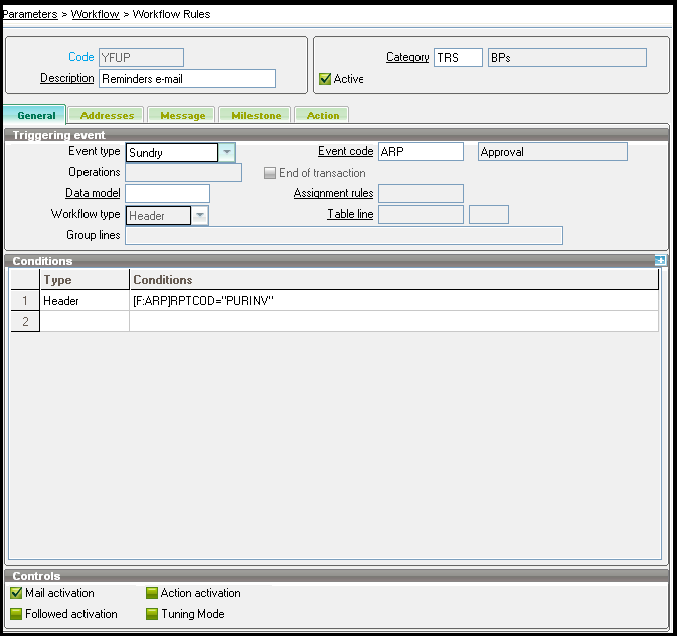
  1. Go to Parameters -> Workflow -> Workflow Rules. Find workflow “FUP”.
  2. Create a copy of “FUP” named “YFUP”.
  3. Remove the “FUP” code from header condition and enter the report code that you need to send. This condition would ensure that the workflow will execute for this report only.
  4. Make sure that ‘Mail Activation’ box is checked at the bottom.
  5. Go to Addresses tab, Select the ‘Business Partner’ option from and type “[F:BPA]WEB” this would get the email address for the concerned Business Partner.
  6. Go to Message tab,
    Object: This is the subject line for the message that can be generated using formulas or text.
    Text: This is a body of the message that can be filled using formulas or text.
  7. Sending option specifies whether the message must be sent locally by the workstation (in MAPI interface), from the server (via SMTP) or equally from one or the other. To use Outlook for sending set the sending option to ‘Client’.
  8. Check ‘Modifiable Message’ if you want to specify the additional recipients’ before mail is sent.
  9. Make sure that “File to attach” is set to “GFILPATH”.
To send the mail to a client, go to invoices screen and open the report through ‘File -> Print’ and select the report to which the workflow has been attached.
Select destination to Message Type and Print. This would start sending the mail to a client and a confirmation message will be displayed before sending. Just allow it and the mail will be sent in no time.
The example and scenario explained above has been kept simple for demonstration. There are a lot of business process or requirements that can be achieved through a workflow.

Entradas populares de este blog

SAGE X3 SILENT IMPORT (IMPORTSIL) WITH ERROR CATCHING

FUENTE ORIGINAL: https://pluginx3.com/en/blog/post/sage-x3-silent-import-importsil-with-error-catching.html You already know how to manually generate a CSV file in order to import it threw a template in Sage X3. But If you wonder how to catch detailed errors after a silent import here is the solution. Sometimes you need to catch the incoming errors in order to alert the end-user regarding an issue. Closed period, wrong date etc …. Unfortunalty the standard Sage X3 silent import function doesn’t natively show the detailed errors during the import process. Call IMPORTSIL([M:IMP2]MODIMP,[M:IMP2]NOMIMP) From GIMPOBJ And the standard function ERR_IMPORT will only show the overall status of the importation and not the detailed errors. IMPORTSIL function is pushing all the log data into a tracefile in order to avoid any popup on end-user screen. So you have a log file available in order to search for errors in it. Sage X3 runtime is using the same principals standards as any shell for log...

Valores de fstat

Fstat fstat  is a numeric status that is returned upon execution of a database operation, a sequential file operation, or a lock instruction. Syntax fstat Examples # MYTABLE is a table with a key called KEY1, that has a unique component called KEYVAL # Create a record in the table MYTABLE with they key value 1 if it doesn't exist Local File MYTABLE [MYT] Read [MYT]KEY1=1 If fstat [MYT]KEYVAL=1 : Write [MYT] If fstat MSG="The key was created in the mean time" Else MSG="Key created" Endif Else MSG="Key already exists" Endif Details fstat  is always set to '0' if the operation is successfully completed, and has a non-null value if there is an error: In a sequential read ( Getseq  and  Rdseq ),  fstat  is set to '1' at the end of the file. On  Lock ,  fstat  is set to '1' if the lock could not be performed. For a database operation ( Read ,  Look ,  Readlock ,  For ,  Write ,  ...

Sage X3 Create a new CLOB Text

Here how to create a CLOB text Funprog F_CRELOB ( YABRFIC , YTEXTE ) Value Char YABRFIC Value Char YTEXTE Local Char XXRTFTXT ( 250 ) ( 3 ) XXRTFTXT ( 0 ) = "{\rtf1\ansi\ansicpg1252\deff0\deflang1033{\fonttbl{\f0\fswiss\fprq2\fcharset0 MS Sans Serif;}}\viewkind4\uc1\pard\f0\fs17 " XXRTFTXT ( 1 ) = YTEXTE XXRTFTXT ( 2 ) = "\par}" Local Char X_RET Local Integer XXOK Local Char XCHAMPLIEN : XCHAMPLIEN = "YYYY" Global Char YYYY : YYYY = YABRFIC Local Clbfile WWCLOB Local Mask ACLOB [ M :ACL ] Setlob WWCLOB With XXRTFTXT [ M :ACL ] CLOB = WWCLOB Call CRE_CLOB_ACL ( XCHAMPLIEN , XXOK ) From TRTX3TEX Close Local Mask [ M :ACL ] X_RET = YYYY Kill YYYY End X_RET