Ir al contenido principal

Hiding fields in Screen Dynamically

You may come across the situation where you would like to hide fields in screen on a particular condition. Sage X3 has a special feature in which you can hide or display fields in with the help of “Chgfmt” keyword.
Chgfmt: It is used to change the format of the mask field. It is also used to display or hide any fields.
Syntax:
Chgfmt [class] field with expr_c
Parameter details:
class:  name of the mask
field:  name of the field
expr_c: expression to hide a field.
Kindly refer to the below snippet of code for better understanding
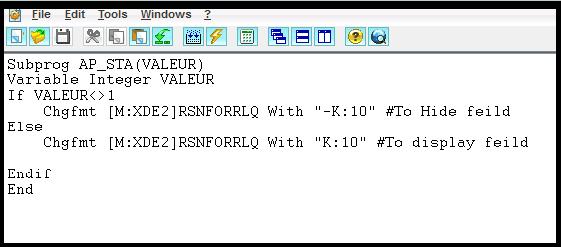
Hiding-1

Pour cacher :

Pour un champ numérique : Chgfmt [M]<champ> With "-N:15"..
Pour un champ alpha: Chgfmt [M]<champ> With "-K:15".

Pour afficher :

+N
+K


Puis affzo

Entradas populares de este blog

SAGE X3 SILENT IMPORT (IMPORTSIL) WITH ERROR CATCHING

FUENTE ORIGINAL: https://pluginx3.com/en/blog/post/sage-x3-silent-import-importsil-with-error-catching.html You already know how to manually generate a CSV file in order to import it threw a template in Sage X3. But If you wonder how to catch detailed errors after a silent import here is the solution. Sometimes you need to catch the incoming errors in order to alert the end-user regarding an issue. Closed period, wrong date etc …. Unfortunalty the standard Sage X3 silent import function doesn’t natively show the detailed errors during the import process. Call IMPORTSIL([M:IMP2]MODIMP,[M:IMP2]NOMIMP) From GIMPOBJ And the standard function ERR_IMPORT will only show the overall status of the importation and not the detailed errors. IMPORTSIL function is pushing all the log data into a tracefile in order to avoid any popup on end-user screen. So you have a log file available in order to search for errors in it. Sage X3 runtime is using the same principals standards as any shell for log...

Valores de fstat

Fstat fstat  is a numeric status that is returned upon execution of a database operation, a sequential file operation, or a lock instruction. Syntax fstat Examples # MYTABLE is a table with a key called KEY1, that has a unique component called KEYVAL # Create a record in the table MYTABLE with they key value 1 if it doesn't exist Local File MYTABLE [MYT] Read [MYT]KEY1=1 If fstat [MYT]KEYVAL=1 : Write [MYT] If fstat MSG="The key was created in the mean time" Else MSG="Key created" Endif Else MSG="Key already exists" Endif Details fstat  is always set to '0' if the operation is successfully completed, and has a non-null value if there is an error: In a sequential read ( Getseq  and  Rdseq ),  fstat  is set to '1' at the end of the file. On  Lock ,  fstat  is set to '1' if the lock could not be performed. For a database operation ( Read ,  Look ,  Readlock ,  For ,  Write ,  ...

Sage X3 Create a new CLOB Text

Here how to create a CLOB text Funprog F_CRELOB ( YABRFIC , YTEXTE ) Value Char YABRFIC Value Char YTEXTE Local Char XXRTFTXT ( 250 ) ( 3 ) XXRTFTXT ( 0 ) = "{\rtf1\ansi\ansicpg1252\deff0\deflang1033{\fonttbl{\f0\fswiss\fprq2\fcharset0 MS Sans Serif;}}\viewkind4\uc1\pard\f0\fs17 " XXRTFTXT ( 1 ) = YTEXTE XXRTFTXT ( 2 ) = "\par}" Local Char X_RET Local Integer XXOK Local Char XCHAMPLIEN : XCHAMPLIEN = "YYYY" Global Char YYYY : YYYY = YABRFIC Local Clbfile WWCLOB Local Mask ACLOB [ M :ACL ] Setlob WWCLOB With XXRTFTXT [ M :ACL ] CLOB = WWCLOB Call CRE_CLOB_ACL ( XCHAMPLIEN , XXOK ) From TRTX3TEX Close Local Mask [ M :ACL ] X_RET = YYYY Kill YYYY End X_RET